
In this article
Imagine a Dallas–Fort Worth driver sending an agent two screenshots. Both show a six-month premium. One is $60 cheaper. The agent spots a collision deductible twice as high on the lower-priced offer. The shopper has a good reason to compare prices and an equally good reason to ask what changed.
Independent agencies can borrow one feature from insurance comparison sites by showing each price beside the terms that produced it. Give the shopper a way to ask a producer about a difference. Then follow that request through a written quote and a bound policy. Those outcomes tell an agency more than a click on “get quotes.”

What does comparison do for purchase consideration?
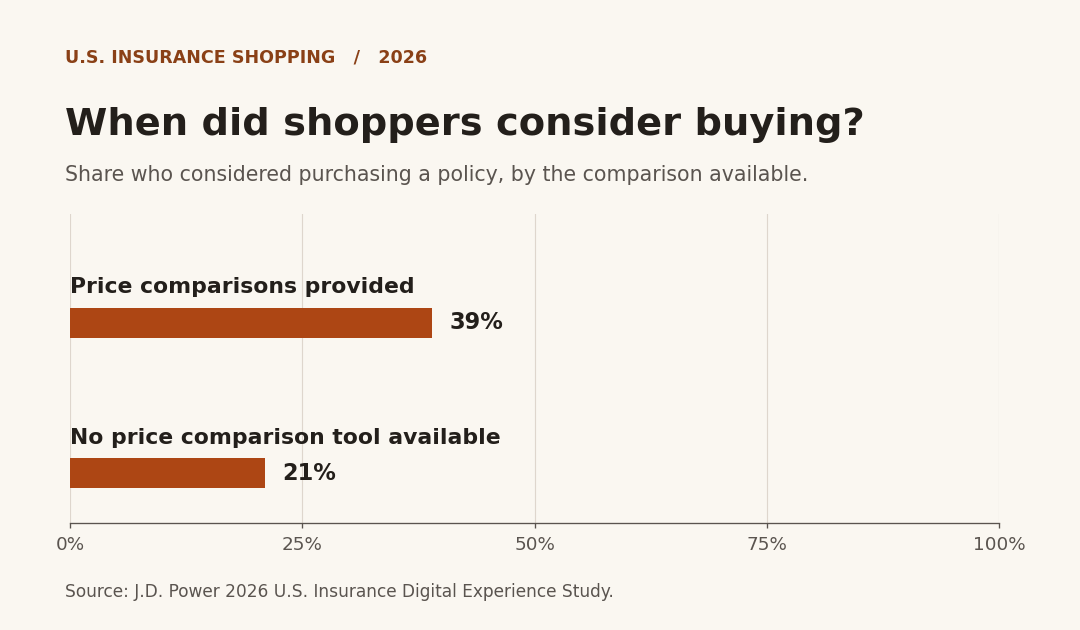
In the 2026 U.S. Insurance Digital Experience Study, J.D. Power found that 39% of shoppers considered purchasing a policy when price comparisons were provided. The share was 21% when no comparison tool was available. That is an 18-percentage-point gap in reported purchase consideration.
The study, conducted with Corporate Insight, drew on 11,553 evaluations of U.S. property and casualty insurance digital experiences from January through March 2026. That total covers shopping and service evaluations. Only about one-third of shoppers encountered price comparisons that included other insurance brands. Read the May 13 J.D. Power study release.
Measuring bound coverage takes a second set of data, from the agency’s own records. Start by testing whether a clearer comparison helps shoppers reach a producer with a request the team can quote.
What has to match before two premiums belong side by side?
For a personal auto comparison, use the same driver and vehicle details, garaging location, policy term and start date. Compare liability limits, collision and comprehensive deductibles, selected options, fees and the discounts the shopper actually qualifies for. Note any difference in exclusions or endorsements that could matter. A producer should review material differences before presenting the offers as comparable.
The Texas Department of Insurance also encourages shoppers to get multiple quotes and compare policies using its worksheet. Give your visitor an easy way to return with the current coverage details or ask for help reading them. See the Texas Department of Insurance auto shopping guide (PDF).
| Quote detail | Example A | Example B |
|---|---|---|
| Same liability limits per person / accident / property | $100k / $300k / $100k | $100k / $300k / $100k |
| Comprehensive deductible | $500 | $500 |
| Initial collision deductible | $500 | $1,000 |
| Initial six-month premium | $720 | $660 |
| Premium with $500 collision deductible | $720 | $705 |
Assume the same remaining terms, fees and verified discounts in this illustration. The initial gap is $60. After the producer asks for a revised B quote at the same collision deductible, it is $15. These fictional amounts illustrate how to read the offers. A real shopper needs current, personalized quotes for the deductibles they are considering.
What should a shopper see before requesting a call?
Show which carriers or options the agency can compare, what facts it needs and what happens after submission. If the screen shows an illustrative premium, label it where the number appears. If a carrier still needs to confirm eligibility or a discount, identify the open item and have the producer explain any resulting change.
Use a handoff that preserves the shopper’s question. A link reading “Ask an agent to match these deductibles” can carry the selected option into the request so the shopper does not have to start again. Offer a choice of available contact methods and give a response window the agency can staff. Keep sensitive application details in the agency’s approved intake system.
Give the receiving producer the comparison reference, the terms checked and the question still open. A request saying “same limits, check rental coverage” gives that producer a useful opening for the conversation.
How many completed requests become bound policies?
Define a completed comparable request as one unique shopper request containing the agreed inputs for the same product and term. Count it even if the agency subsequently cannot place it. Keep missing inputs, duplicate submissions and applications for a different product visible in separate counts.
Consider a fictional group of 500 shoppers who viewed the comparison. Follow each completed request for 30 days and count the shopper once at each stage, even if several carriers returned quotes.
- 100 shoppers completed a comparable request.
- 87 requests reached a producer.
- 72 shoppers received a written quote.
- 18 had a policy bound during the follow-up window.
The result is 18 bound policies per 100 completed comparable requests. Among the 72 who received a written quote, 18 bound, or 25%. The first measure includes the 13 requests that never reached a producer. The second helps the producer review what happened after a quote went out. Counting only the latter would hide the handoff problem.
Which improvement should the brokerage test first?
Review ten recent comparisons alongside the producer who handled them. Where terms often differ, fix the row labels or add a reason a like-for-like quote is unavailable. Where complete requests go unassigned, fix routing and ownership. Where written offers stall, ask what the shopper still wanted to compare before changing the form.
Run the test on one line of business. Compare equally mature request groups and note changes in carrier availability or pricing during the period. If your team also buys leads, keep those costs and outcomes in a separate comparison. AVP’s guide to cost per bound policy for shared and exclusive leads addresses that acquisition decision.
Bring a redacted pair of quotes and one month of request outcomes. AVP’s Dallas–Fort Worth insurance agency marketing team can help identify the first comparison or handoff to improve.