
In this article
A patient opens a visit summary and asks the front desk, “Did a person read this before it came to me?” A website statement that the practice uses innovative technology leaves the one question that matters unanswered.
Explain the specific task the tool performs, who reviews its output, when that review happens and how a patient can raise a concern. Patients in a national survey gave very different answers depending on the role their provider played. A clinic can put that insight to work by describing one verified workflow in language its patients recognize.

What did patients say about AI in healthcare?
West Health and Gallup asked 5,330 U.S. adults who had seen their primary care provider in the preceding year about several uses of AI in healthcare. The probability-based panel survey ran August 12–24, 2026. Its November 9 report separated the question of diagnosis and treatment decisions into three arrangements.
When the provider could override a decision made by AI, 56% said they were somewhat or very comfortable. When AI supplied input and the provider made the decision, 38% said they were comfortable. Only 9% said so when AI made the decision without provider review. Each percentage describes a separate scenario, and a respondent could be comfortable with more than one. Read the West Health–Gallup findings and question descriptions.
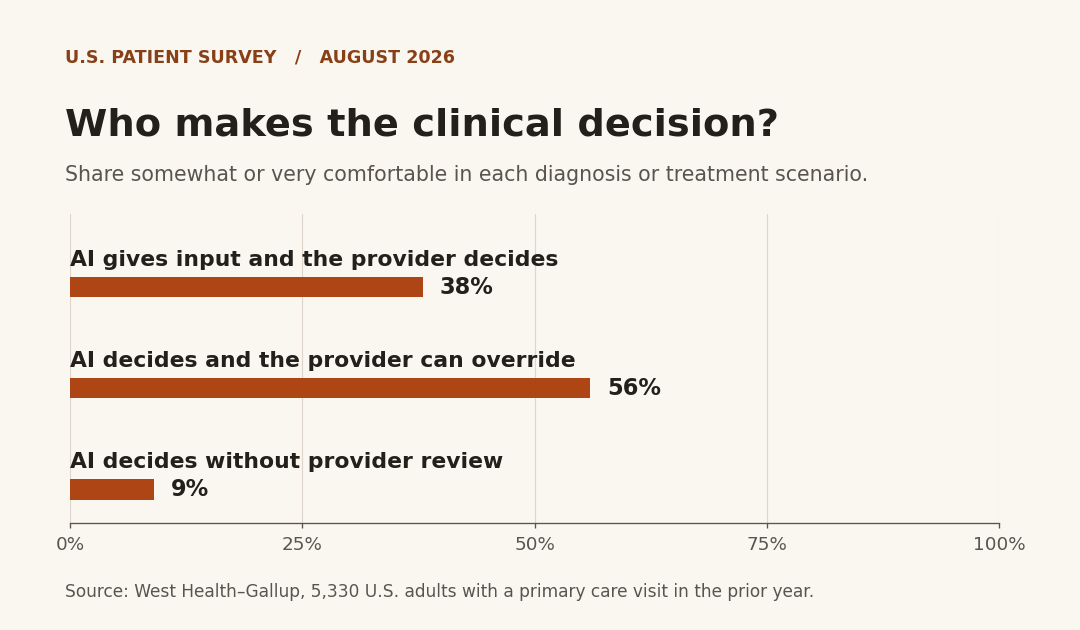
The difference between the override and no-review scenarios was 47 percentage points. That figure describes comfort with hypothetical clinical decisions. Consent, clinical accuracy and attitudes toward visit notes are separate questions. A practice writing about documentation needs to describe its own process.
Which details can your clinical lead confirm?
Start with the patient touchpoint that prompts questions. It may be a note in the portal, an appointment reminder or a message that appears to come from a member of the care team. Ask the clinical lead and the person who operates the workflow to walk you through one example using a blank template. Keep patient records out of the copy review.
| Ask the clinic | What the writer needs |
|---|---|
| What does the tool do here? | The exact task, such as preparing a first draft of a visit summary. |
| Who sees it before the patient does? | The responsible role, the timing and what happens if the reviewer is unavailable. |
| What can the reviewer change? | What can be corrected, rejected or withheld before release. |
| How can a patient ask about it? | A staffed phone or portal route and the person who receives the question. |
“A clinician can edit the text” and “your clinician checks every summary before you see it” describe different arrangements. Ask which one applies to that service at that location. If some messages go out automatically, a sitewide promise that every message gets human review would mislead patients.
What might a plain-language explanation look like?
Imagine an outpatient group confirms that the tool drafts summaries from its clinicians’ notes, that a clinician checks each draft before release and that the office accepts questions by phone or portal. That group could place the following wording beside the summary.
We use software to draft your visit summary from your clinician’s notes. Your clinician reads the draft and can change it before you see it. If something looks wrong or you want to ask how the summary was prepared, send a portal message to your care team or call the office.
The example names the task, the reviewer and the route back to a person. A clinic that records a conversation, or uses a tool only to send scheduling reminders, needs different wording. Before promising a choice such as requesting another process, check what staff can actually offer and how the patient can request it.
Put the short version where the patient encounters the feature. Give reception the same answer and a way to reach the right colleague. If the practice publishes in multiple languages, have speakers of each language check that the reviewer and contact route are still clear.
Can a patient explain who checks the work?
Show the proposed notice in its intended place and allow the reader to look at it while answering. Ask, “Who checks the summary before you receive it?” and “If a detail looks wrong, how would you contact us?” Record the substance of the answers. An encouraging nod tells you less than hearing the person describe the next step.
This borrows the own-words principle from teach-back. Here the practice is testing the clarity of a website notice. It does not need to ask about anyone’s health. See the teach-back toolkit from the Institute for Healthcare Improvement.
Suppose six of eight volunteer readers identify the clinician as reviewer, but only four can find the correction route. Those are illustrative counts. The first edit would be to make the contact instruction easier to spot, then try the revised notice with new readers. Report the counts and the words people misunderstood. Eight readers cannot estimate trust across the whole practice.
Who keeps the explanation accurate after launch?
Give the notice an owner in the practice. Record the workflow, the reviewer role, the approved wording and the date checked. When the software, release timing or staffing changes, have that owner compare the live copy with what now happens. A front-desk question that keeps coming back can be an early signal that the workflow or wording has changed.
If patients understand who reviews a summary but still have concerns, give staff time and a clear route for that conversation. A comprehension score cannot stand in for a patient’s preference. For a way to choose the next explanation from recurring questions, see AVP’s guide to patient education topics from the front desk.
Bring one confirmed workflow and the patient question your team hears most. AVP’s San Diego healthcare marketing team can help turn them into clear patient-facing copy.